Be yourself; Everyone else is already taken.
— Oscar Wilde.
This is the first post on my new blog. I’m just getting this new blog going, so stay tuned for more. Subscribe below to get notified when I post new updates.
Be yourself; Everyone else is already taken.
— Oscar Wilde.
This is the first post on my new blog. I’m just getting this new blog going, so stay tuned for more. Subscribe below to get notified when I post new updates.
Before proceeding towards the definition given in the legal enactment(s) one must know its literal meaning. The term ‘Admission’ means stating something or admitting something other than guilt. So now the question is does confession also meant the same. The answer is no, as there is a very thin life difference between confession and admission. The word ‘confession’ means acknowledgment of guilt made by a person after an offense has been committed.
ADMISSION {Sec. 17-23, 31}
According to sec. 17 of Indian Evidence Act, admission is a statement, oral or documentary or contained in electronic form, which suggests any inference as to any fact in issue or relevant fact, and which is made by any of the persons, and under the circumstances, as described under Indian Evidence Act.
Admission is a substantive piece of evidence but not conclusive proof also it waives or dispenses the production of evidence by concealing that the fact asserted by the opponent is true. In the case, Raja Pratap Bahadur Singh v. Raja Rajgan Maharaj Jagatjit Singh [1936 Lucknow] it was held that admissions are a very weak kind of evidence and the court may reject the same if it is satisfied from other circumstances that they are untrue. Hence it shifts the onus to the maker on the principle that what a party himself admits to being true may be reasonably presumed to be true so that until the presumption is rebutted the fact admitted must be taken to be true.
In English Law, the term ‘admission’ is used only in civil cases but in Indian laws, it is used in both civil as well as criminal cases. The statement is a genus; admission is the species and confession is the sub-species. Admission will lose its effect if not made voluntarily.
WHO CAN MAKE ADMISSION
Sec. 18 of the Indian Evidence Act allocates classes of person who all can make an admission-
• Party to the proceeding
• Agent authorized by such party [ but the statement of agent will be binding only during the term of agency and before proving admission by the agent he has to prove his agency ]
• Party suing or sued in a representative character making admission while holding such character [it will include trustees, executors, administrators, managers, etc.]
• Person who have a proprietary or pecuniary interest in the subject matter of the proceeding
• Person from whom parties have derived the interests in the subject matter of the suit
Admission of a fact made by a pleader in the conduct of the suit on his client’s behalf is binding on the client. But a party is not bound by a pleader’s admission in an argument on what is a pure question of law.
An exception to Sec. 18-
Sec 19 – Admissions by persons whose position must be proved as against party to suit
Sec. 19 states that any third party gives such a statement that proves the liability and right against any party to the suit will be admissible. The object of this section is not to lay down that certain statements are relevant or admissible but merely to add the category of a person by whom a statement made before considered to be an admission within the terms of the act.
Sec. 20- Admissions by persons expressly referred to by party to suit
When the party expressly refers to the third person for some information in reference to the subject matter which is in dispute then the statement made by the third person will be admissible.
Sec. 19 and Sec 20 are exceptions to the rule that statements made by strangers to a proceeding are not admissible within the terms of the act.
It is a general rule that admission cannot be proved on or on behalf of a person who makes it but sec. 21 is an exception to this general rule. Sec. 21 has three clauses which state that-
• Person making the admission was dead and hence his admission made earlier during his lifetime will be admissible (Sec. 32)
• When the statement is about the existence of any state of mind, body, or about the time when such state of mind or body existed and accompanied by the conduct then that statement will be held admissible (sec. 14)
• When the fact is not otherwise relevant to become relevant (Sec11)
ORAL ADMISSION-
Admission can be made either orally, documentary or in electronic form as mentioned in Sec.17. But sec. 22 and Sec. 22 A deals with when oral admission as to contents of document or electronic form will become relevant.
Oral admissions as to the contents of a document are not relevant, unless and until the party proposing to prove them shows that he is entitled to give secondary evidence of the contents of such document under the rules hereinafter contained, or unless the genuineness of a document produced is in question.
For Example- Atul executed a deed of the mortgage against Deeba. Later Deeba files a suit for possession of the property but during the trial, Atul denied the existence of any such deed. So in this case Deeba Can’t prove by oral evidence that she has before some men admitted that Atul mortgaged a deed. She has to produce the original deed in a court of law.
ADMISSION IN CIVIL CASES- Sec. 23
In civil cases if it appears to the court that parties to the suit have mutually agreed together that evidence should not be given or made upon an express condition the evidence not to be given then any admission made related to it will be irrelevant. But this section will not discharge any barrister, advocate, attorney, pleader from giving evidence which he is compelled to give u/s 126 of Evidence Act.
This section gives effect to the maxim ‘interest reipublicae ut sit finis litium’ which means it is for the interest of the state that there should be an end to litigation.
ADMISSION ACT AS AN ESTOPPEL
Sec. 31 of the Indian Evidence Act states that Admissions are not conclusive proof but they act as an estoppel.
Estoppel has been defined in Sec. 115 of the evidence act. The bare reading of section 115 of the said act is-
“When one person has, by his declaration, act or omission, intentionally caused or permitted another person to believe a thing to be true and to act upon such belief, neither he nor his representative shall be allowed, in any suit or proceeding between himself and such person or his representative, to deny the truth of that thing”
CONFESSION
Confession has not been defined anywhere in the Act. A ‘confession’ is an admission made at any time by a person charged with a crime, stating or suggesting the inference that he committed the crime. It is also said that every confession is an admission but every admission is not a confession. The substantive law of confession is contained in Sec. – 24 to 30 of the evidence act and the procedural laws in Sec. 164,281,463 of the Criminal Procedure Code. It is presumed that a person will not make an untrue statement against his own interest. It has been held in Palvinder Kaur v. State of Punjab[ AIR 1952] that confession must either be accepted or rejected as a whole and the court is not competent to accept only the inculpatory part while rejecting the exculpatory part as incredible. Moving towards the further procedures of confession, let’s see what are the laws related to it.
WHEN CONFESSION WILL BECOME IRRELEVANT {Sec. 24-26}
Sec. 24- Confession caused by inducement, threat or promise, when irrelevant in a criminal proceeding.
Sec. 24 of the Indian Evidence Act states that—A confession made by an accused person will become irrelevant in a criminal proceeding, if it appears to the Court that the confession has been caused by any inducement, threat or promise, having reference to the charge against the accused person and such inducement, threat, promise has proceeded from a person who is in authority and is sufficient, in the opinion of the Court, to give the accused person grounds, which would appear to him reasonable, for supposing that by making it he would gain any advantage or avoid any evil of a temporal nature in reference to the proceedings against him.
Here authority is not merely a police officer or a judicial magistrate but every such person who reasonably holds sway over investigation or trial.
Sec. 28 make this section relevant only if the threat, promise, or inducement is fully removed before recording the confession.
Sec. 25 – Confession to a police officer
A confession made to a police officer shall not be proved against an accused who made it and this confession will be held as inadmissible. The reason behind this is police officers are often regarded as untrustworthy.
But in the case Sita Ram v. State of UP [AIR 1966 SC], a confession was written to a letter and signed by the accused and addressed to a police officer was held to be admissible as the letter was not written in the presence of police officer.
Sec. 162 of CrPC also enacts that no statement made by any person to the police officer in the course of an investigation shall if taken down in writing, be signed by the person making it, then such writing will not be used as evidence.
Sec. 26 – Confession in police custody
A confession made by any person in the custody of police will be held inadmissible unless it shall be recorded in the immediate presence of the Magistrate.
The object of Sec. 25 and 26 is to prevent the practice of torture by the police for the purpose of extracting a confession from the accused person. A confession made by any person in the custody of police is held inadmissible in law because it is against the rule of natural law. The presence of the Magistrate secures the free and voluntary nature of confession.
HOW MUCH OF INFORMATION RECEIVED AGAINST ACCUSED MAY BE PROVED
Sec. 27 of the act states that if the confession of the accused is supported by the discovery of a fact then it may be presumed to be true and not to have been extracted and it comes into operation only if-
• When certain facts are deposed to as discovered in consequence of information received from an accused person in police custody.
• If the information relates distinctly to the fact discovered.
This section is an exception to Sec. 25 and 26. The object of this section is to admit the evidence which is relevant to the matter under inquiry namely the guilt of the accused and not to admit the evidence which is not relevant to that matter. The very first condition to bring sec. 27 into operation is the discovery of a fact in pursuance of information received from the accused. Where the accused made the disclosure statement leading to the discovery of offense then the statement of the accused will be admissible.
CONFESSION OTHERWISE RELEVANT NOT TO BECOME IRRELEVANT
Sec. 29 of the Indian Evidence Act states that, if the confession is made under a promise of secrecy or in consequence of deception which has been practiced on the accused, or when he was drunk, or when it was made as an answer for a question which the person making it is not supposed to answer or if he was not warned that he was bound against his confession, for the purpose of obtaining it then such confession will not become irrelevant.
Sec. 164 of CrPC provides the formalities to be undergone by a Magistrate in recording confession. The magistrate has a duty to explain the pros and cons. Of confession to a person making it. But the abovementioned section does not make a confession irrelevant because the accused was not warned that he was not bound to make it.
Sec. 30 of the act states that when more than one person is jointly accused of the same offence and if one of the co-accused makes a confession regarding himself and some other such persons, the court will take that confession into account against the accused and his co-accused. In Kashmira Singh v State of MP (AIR 1952 SC159), the court held that the confession of an accused person against a co-accused will not run evidence as it does not come within the meaning of evidence contained in sec.3 of the evidence act.
CRITICAL ANALYSIS-
After all the terms “confession and admission” were coined for evidentiary use, courts have endeavored to draw clear distinctions between them. Conclusively, it can be said that the admission has a vast scope than confession, as the hindmost comes under the ambit of the former. Hence, every confession is an admission, but the reverse is not true.
The major difference between these two is that in the case of confession, the conviction is based on the statement itself, however, in the case of admission, additional evidence is required, to support the conviction. The distinction between a confession and an admission is not based upon a practical clarification but is based upon the substantive differences of the character of the evidence extrapolated from each. This is to say, a confession is a direct acknowledgment of guilt, on the part of the accused, and by the very definition of it, ostracized an admission which of itself is a statement, oral or documentary, that enables the court to recollect a conclusion as to any relevant fact or fact in issue. It will be meticulously to say that every confession, is an admission but every admission doesn’t necessarily amount to a confession. In other words, a confession is an admission provided that a person charged with a crime, standing or suggesting the inference that he committed the crime, makes it at any time.
Indira Gandhi, daughter of the pragmatic leader, idealistic constitutional democrat, and pioneer of Constituent Assembly who played an eminent role in nurturing secularism after partition, Jawaharlal Nehru. Nehru served the post of Prime Minister for seventeen years. Considering her father as a source of ingenuity she used to witness him which materialized her to serve the chair of Prime Ministership. Hence she served as Prime Minister from January 1966 to March 1977 and again from January 1980 until her assassination in October 1984, making her the second longest-serving Indian prime minister after her father. In 2020 Gandhi was designated as the world’s 100 powerful women by Time Magazine among those who defined the last century. She was known for her political tenacious and unprecedented centralization of power.

During her tenure, she tried to bring several amendments some of them are discussed below.
24th Amendment –
Indira Gandhi instigated 24th Amendment which came into force on 5th November 1971. The Hon’ble Supreme Court in Golaknath v. State of Punjab (AIR 1967 SC 1643) overruled Sankari Prasad v. Union of India. In Sri Sankari Prasad Singh Deo vs Union Of India (1951 AIR 458) 1st constitutional amendment act, 1951 was challenged and Art. 13 and Art. 368 came into conflict. In this case, the court held that Parliament can amend any part of the Indian Constitution and have absolute power. In the Golaknath case court restored the absolute power of parliament to amend any part of the Indian constitution and in addition, held that fundamentals rights cannot be amended ever. This act also provides that when a Constitution amendment bill has been passed by both the house of parliament and forwarded to the president for his assent, he is bound to give his assent. This act also added Art.13(4) and 368(3) where Art. 13 (4) says “Nothing in this article shall apply to any amendment of this Constitution made under article 368.” A new marginal heading was substituted to article 368 in place of the old heading “procedure for amendment of the constitution”. The new heading is “power of parliament to amend the constitution and procedure thereof.24th Amendment Act made clear that provisions in article 13 do not apply to a constitutional amendment made under article 368. From here itself a tussle has been started between Government and Hon’ble Supreme Court. Along with this bank, nationalization took place which also became a matter of dispute between Government and Hon’ble Supreme Court.
25th Amendment-
The 25th Constitutional Amendment act, 1971 curtailed Right to Property and provided that any law made to give effect to the DPSP contained in Art. 39(b) or (c) cannot be challenged on the ground of violation of the rights guaranteed under Art.14, 19, and 31 of Indian Constitution. This act gives an eminent power to the government to compulsorily acquire the property of any person and the price of the property will be decided by the government itself.
29th Amendment-
In subsequent to this, a very crucial case came into a picture named Kesavnanda Bharti v. State of Kerala(AIR 1973 SC 1461). It was the largest bench comprising of 13(ratio was 7:6) judges of Hon’ble SC. Kesavnanda Bharti was the head of Edneer Mutt in Kerala. Kerala Gov. passed a law that attempted to control religiously owned property under the Two-State Land Reform Act. Art. 26 of the Indian Constitution gives power to Indian citizens or trust to manage any religious institution property. The bare reading of Art. 26 is:-
Freedom to manage religious affairs Subject to public order, morality and health, every religious denomination or any section thereof shall have the right
(a) to establish and maintain institutions for religious and charitable purposes;
(b) to manage its own affairs in matters of religion;
(c) to own and acquire movable and immovable property; and
(d) to administer such property in accordance with law
Nana Palkhiwala, a senior and reputed advocate of Hon’ble SC convinced Kesavnanda Bharti to file a PIL in Kerala HC in the violation of Art.26 by the virtue of Art. 226. The petitioner has challenged the validity of the Kerala land reforms act, 1963, and later during the pendency of petition Kerala Act amended the Act in 1971 and it was placed in the 29th constitutional amendment act. Hence the petitioner challenged the validity of the 24th, 25th, and 29th Amendments to the Constitution. Later this case was transferred to Hon’ble SC where the hearing of court continues to 68 days. Hon’ble SC, in this case, held that Parliament can amend any part of the constitution including fundamental right but the amendment cannot alter its basic structure of the Constitution and also declared Preamble as an integral part of the Indian constitution.
Where basic structure may be said to consist of the following features:
(1) The supremacy of the Constitution;
(2) Republican and Democratic form of Government.
(3) Secular character of the Constitution;
(4) Separation of powers between the Legislature, the executive and the judiciary;
(5) Federal character of the Constitution.
39th and 41st Amendment-
But this case didn’t stop here it has several dimensions. In 1975, Allahabad High Court set aside the Indira Gandhi election which eventually led to the Emergency. The 39th Amendment to the Constitution was to ensure that elections of the president, vice-president, prime minister, and speaker could not be questioned in any court of law but before another forum prescribed by Parliament. Further, any judgment that set aside the election of any of these four functionaries was deemed to be void and all elections of these four functionaries were always to be deemed to be valid in all respects. This amendment was held to be violative of the basic structure and struck down. Justice J.L. Sinha not only set aside Gandhi’s election from Rae Bareli, but also disqualified her from contesting elections for six years.
Aggrieved with struck down of 39th Amendment she again passed the 41st Amendment Bill which prohibited any civil or criminal proceedings against the president, vice-president, prime minister, and all governors. Thus, any person who committed a serious crime could become immune from any criminal action if he held the office of governor for just one day. If the power of Parliament had not been fettered by the basic structure, this would have become law. Including this appointment of the president the term of office will only from 6 months to 12 months and not more than that. But this amendment was also held violative of basic structure and struck down.
She didn’t stop here. She has to suppress all establish a reign of terror and therefore in order to continue as PM declared national emergency from 1975 to 1977 and suspended Articles 14, 21, and 22. People who were illegally detained approached to Hon’ble HC for the enforcement of Fundamental right enshrined under Art. 21 several opposition leaders were detained under MISA Act, 1971 (maintenance of Internal Security Act).
42nd Amendment-
This amendment Act, 1976 was enacted during the period of emergency by Indira Gandhi. This amendment was the most controversial amendment in history and also called mini-constitution as almost every part of the Constitution has been changed including the Preamble. The word ‘Secular’ and ‘Socialist’ was added in the preamble. This amendment gives uncontrolled power to amend the constitution to parliament while reducing the power of Hon’ble HC and SC without Judicial Review.
During this era Judicial independency was in danger and then came a case ADM Jabalpur v. Shivkant Shukla(AIR 1976 SC 1207) popularly known as Habeas Corpus case comprising of 5 judge bench (ratio 4:1). Petitioners were detained under the above-mentioned act during emergency where all the petitioners approached different Hon’ble HC under Art. 226 for issuance of Habeas Corpus Writ and challenged the illegal detention. But the Hon’ble HC did not examine the validity of proclamation hence the case came before the Hon’ble SC by way of appeal against the order of Hon’ble HC. Where Hon’ble SC gave its majority judgment where it held Sec. 18 of MISA Act is valid and when President under Art. 359(1) has suspended the fundamental right to be executed by the court then by the virtue of Art. 226, no one has any locus to file any writ to challenge the illegality of detention order. This judgment was termed as a black day of the Judiciary. In this case, Justice H.R. Khanna played an eminent role by giving dissenting judgment after aware of the fact that he will have to cost his chair of chief Justiceship. He alone held that even if a person’s fundamental right has been taken away then also he/ she can proceed towards the court of law to know the reason behind their detention. He also held that life and liberty cannot be granted on the mercy of executive and rule of law does not allow the government to illegally detain any person.
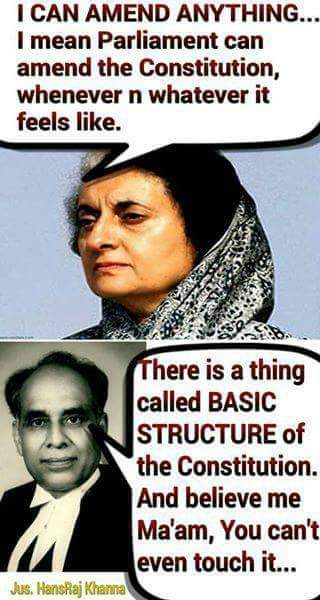
Mrs. Gandhi angered with the dissenting judgment broke the seniority procedure for appointment of Chief Justice of India and appointed Justice AN Ray by superseding three judges of the court. Justice Khanna during the pendency of this judgment told to his sister that his views in the said judgment will cost the chair of Chief Justiceship of India.
Justice Khanna was the epitome of Judicial Independence. His dissenting judgment has definitely cost the chair but he gained a bucket full of respect across the world. Kushwant singh wrote about Justice Khanna – “so clean a man that he makes angels looks disheveled and dirty”. I am a bit sure that there would be no justice like Justice Khanna.
As every coin has two sides, uniformly Indira Gandhi was not only the part of getting criticized but also praised for her numerous acts. During her nonage, she was called a Goongi Gudiya but later on, she became lionhearted and daredevil which was witnessed by the world. Vengeance and rage drove her politics. She was India’s most powerful prime minister because when it came to using and manipulating power she left even her father, flat on the mat. Mrs. Gandhi’s prestige reached a height of zenith when she led India in a successful December 1971 war against Pakistan.
Judiciary is the system of law courts that administers justice and also constitute Judicial Branch of Government. The court’s duty is to apply the laws and settle the disputes. Restricting the Supreme Court, India has no federal Judiciary like the United Nations. Each state has its own Judiciary which administer(s) both Union and State laws. Well in India court(s) have been divided into three categories: Top court i.e. Supreme Court and High courts , Subordinate Court i.e. District Courts and Lower Court i.e. Judicial Magistrate and Civil Judge Junior Division Courts. I am quite sure that a maximum no. knows about the procedure for appointment of judges in higher as well as middle Judiciary but when it comes to the lower judiciary, the majority fails to answer. Therefore to help you all, we couldn’t resist ourselves penning down on this subject matter. We will give a brief about the appointment of Judicial Magistrate and Civil Judge Junior Division in Lower Judiciary, but after going through the procedure of appointment we must know the classification of courts under the Indian Judicial System.

A Judicial Magistrate is that judicial officer of a state who handle(s) minor cases in the specific area comprises of towns, sub-districts, districts, etc. and have limited Judicial powers. Before the pre-independence period Warren Hasting introduced two courts in 1772 namely Diwani Adalat which deals with all civil matters in a district and this court were presided by Collector and the other one is Faujdari Adalat which deals with all type of criminals matters where it was presided by Kazi or Mufti along with 2 maulvis and collector had direct control over this court. But after the enactment of the Indian Constitution it laid down the current legal framework of the legal system and the current Judicial System derives its powers from it.
Now moving forward towards the appointment of Judicial Magistrate and Civil Judge Junior Division in civil and criminals courts. Article 234 of the Indian Constitution talks about appointing authority. The bare reading of Art. 234 is as follows;
‘Appointments of persons other than district judges to the judicial service of a State shall be made by the Governor of the State in accordance with rules made by him in that behalf after consultation with the State Public Service Commission and with the High Court exercising jurisdiction in relation to such State.’
Therefore the Law Commission or State Public Service Commission holds examinations for the appointment of Judicial Magistrate and Civil Judge Junior Division in three-tier i.e. Preliminary round, Mains or theoretical round, and the last one is interview round. Any fresh law graduate between the age of 22-35 years is deemed to be eligible to hold the capacity. A candidate who qualifies this examination will preside as a Judicial Magistrates in Criminal court and Civil Judge Junior Division in civil court.
Further, the Code of Criminal Procedure provides the constitution of criminal courts in chapter Chapter II where Sec. 11,12,13 talks about courts of Judicial Magistrate.
Sec 11 of CrPC:-
It states that in every district other than metropolitan area there shall be established as many Courts of Judicial Magistrates of the first class and of the second class as the State Government may, after consultation with the High Court and establish, for any local area, one or more Special Courts of Judicial Magistrates of the first class or of the second class to try any particular case and where any such Special Court is established, no other Court of Magistrate in the local area shall have jurisdiction to try the case of which such Special Court of Judicial Magistrate has been established. The presiding officers of such Courts shall be appointed by the High Court.
Sec 12 of CrPC:-
In every district other than the metropolitan area, the High Court shall appoint a Judicial Magistrate of the first class to be the Chief Judicial Magistrate, any Judicial Magistrate of the first class to be an Additional Chief Judicial Magistrate, and such Magistrate shall have all or any of the powers of a Chief Judicial Magistrate.
Sec 13 of CrPC:-
The High Court may, on request of Central or State Government confer upon any person who holds or has held any post under the Government, all or any of the powers conferred on a Judicial Magistrate of the first class or of the second class, in respect to particular cases in any local area, not being a metropolitan area and they shall be appointed for a term, not exceeding one year.
Thus by the abovementioned sec. we saw that powers to appoint Judicial Magistrates is distinctive in nature and the power vests with the Higher Courts and the Governments of the respective States. The Code of Criminal Procedure, 1973 provides for the appointment of different magistrates in different states, the step by step procedure for an appointment may vary from state to state depending upon the policies of such State Governments. Every State has made rules for the recruitment of Judicial Magistrate and Civil Judge Junior Division to the State Judicial Service. Consistent with the constitutional provision, most of the States have in their respective rules for the subordinate judiciary, conferred power on the State Public Service Commission to select and recommend candidates for posts in the subordinate judiciary where the recruitment is from the market.
There is some lacuna regarding the examination of PCS(J) and the major one is that this examination is not certain and inconsistent, PCS(J) exam is held quite irregularly, including the announcement of its result that makes it difficult for students to pursue their career in the judiciary. If centre, in reality, wants to decrease the no. of pendency of cases it must urge the state to hold examination every year because the pendency of cases is not a single State problem.
If the judgment skills of only Judges are important to provide Justice then it would be ‘Justice to all(whosoever approaches the court of law)’. Similarly, everybody deserves justice and prima facie its duty of every single person to do justice in every day to day transaction. In the late September 2017, three persons, Registrar (Recruitment) Balwinder Sharma and two beneficiaries Sunita and Sushila, were booked by the police in the Haryana Civil Services (Judicial) paper leak case. The high court full bench comprising justice Rajesh Bindal, justice Rajan Gupta and justice GS Sandhawalia also ordered a suspension of Dr. Balwinder Kumar Sharma and found him liable under Sec 8 (taking gratification, in order, by corrupt or illegal means, to influence public servant), 9 (taking gratification, for the exercise of personal influence with public servant) and 13(1)D (criminal misconduct by a public servant) of the Prevention of Corruption Act,1988. To stop paper leak incidents in the future, the State Public Service Commission may stop printing question papers at their end and instead send paper CDs to the exam centers, just an hour before the exam.

The aforesaid picture was published by outlook in one of its magazines as a cover story.
Deputation in the base of Judicial System is eternally a deed of great and valuable responsibility. The engagement of deputation has been comprehensively commissioned to State Public Service Commission.
Quoting the wordings of William Penny, “to delay Justice is injustice”, and by drawing a conclusion from this statement the main task is to make the deputation of Judges free from all the irregularities. As the base of Judicial System is mainly implanted by the Civil court(s) and Magistrate court(s), and hence to reduce the pendency of cases the appointment should be regular.
Lower Courts are mainly established to exercise the original jurisdiction and the rest of the court(s) (i.e. Hon’ble Supreme Court, Hon’ble High Court(s)) are established mainly for entertaining the appellate jurisdiction(s) but several original jurisdictions has been delegated to these courts by several Constitutional and statutory provisions.
The shortage of Judicial Officers clasps the major contention for the delay in Justice delivery.
By taking reference from three judges case (i.e. S.P. Gupta v The President, AIR 1982 SC 149, SC Advocate-on-record v Union of India, In re Presidential Reference, AIR 1999 SC 1), it can be taken into consideration that the duty of appointment of Judicial officers should be delegated upon the High Courts. As several High Court(s) like Madhya Pradesh High Court is responsible for the appointment of Judicial officers in Lower Judiciary and it can be witnessed over there that the deputation is regular compare to other states where public service commission is responsible for the said task.
Why judiciary, why reforms or dilemmas of this organ is so important?
We have suffered and witnessed the colonial rule and their suppressing legislations. Now as we have attained freedom, its the Constitution which secures our freedom, our right, our liberty, etc. The Supreme Court is known as the interpreter and watchdog of our constitution but on the other hand, its the lower judiciary which provides justice to a tremendous percentage of the population for whom approaching the Supreme Court costs them fortune (that’s altogether a different topic for discussion). The impartiality and commitment to a job are what is required. Uniformity and the Supreme Court’s supervision could be the solution for time being.
Indeed the post holds some expectations with it but it can only be justified by one who holds it.
(Co-authored by Deeba Faryal, Atul Verma and Shivang Jain)

INTRODUCTION–
India is a democratic country where politics of India works within the framework of the country’s constitution i.e. Indian Constitution. Indian Constitution is the supreme law of India. Its a draft which lays down the framework differentiating fundamental political code, structure, procedures, powers, and duties of government institutions and sets out fundamental rights, directive principles, and the duties of citizens. Every citizens have been granted by fundamental rights which they can exercise and approach the courts if any of the fundamental rights has been violated via Art. 226 & 32. The Freedom of speech and expression is the first and foremost human right, the first condition of liberty, mother of all liberties, as it makes the life meaningful which is termed as an essence of free society. The purpose of this freedom is to allow an individual to attain self-fulfilment, assist in discovery of truth, strengthen the capacity of a person to take decisions and facilitate a balance between stability and social change. Now what if this fundamental right is being restricted by the Government in certain case(s).
Sedition is a conduct or speech inciting people to rebel against the authority of a state or one can say defamation against government. Now the question is how it is connected with Art. 19 and Art. 21 of the constitution. Let’s see how did it came into force.
HISTORY–
When IPC was drafted in 1860, sedition was originally not a part of it. It was added in the IPC in the year 1870 and at that point in time Wahabi Movement was going on. The intent of the section was to punish an act of exciting feelings of disaffection towards the government, but this disaffection was to be distinguished from disapprobation. Thus, people were free to voice their feelings against the government as long as they projected a will to obey its lawful authority. The first case was registered, in 1891, when the editor of a newspaper called Bangobasi was booked for publishing an article criticizing an “Age of Consent Bill.” The jury could not reach a unanimous verdict and the judge, in that case, refused to accept any verdict that was not unanimous. The editor was released on bail, and, after he issued an apology, charges against him were dropped. When Bal Gangadhar Tilak, Maulana Azad and Mahatma Gandhi; the prominent personalities when booked under sedition it changed the effect of section 124 A in 1897. Bal Gangadhar Tilak pleaded before the judge that he is not promoting disaffection towards government established by law. But the Judge contended that it is true that you are not promoting any sort of disaffection toward the government established by law but there is lack of affection and this absence of affection renders Tilak to be booked under sedition and he was sentenced to 6 years. And then India got independence and drafters were busy framing the new constitution for the people of this country. From the Constituent Assembly Debates there had been serious opposition for inclusion of sedition as a restriction on freedom of speech and expression under the then Article 13 of the draft Indian Constitution. Such a provision was termed as a shadow of colonial times that should not see light of the day in free India. The Constituent Assembly was unanimous deleted the word sedition from Article 13 of the Constitution but it remained as it is in the penal statute post-independence.
DEFINITION OF SEDITION–
124A. Sedition.—Whoever, by words, either spoken or written, or by signs, or by visible representation, or otherwise, brings or attempts to bring into hatred or contempt, or excites or attempts to excite disaffection towards, the Government established by law in India, shall be punished with imprisonment for life], to which fine may be added, or with imprisonment which may extend to three years, to which fine may be added, or with fine.
This sec. includes 3 explanation as an exception mentioned herein after:-
Explanation 1.—The expression “disaffection” includes disloyalty and all feelings of enmity.
Explanation 2.—Comments expressing disapprobation of the measures of the Government with a view to obtain their alteration by lawful means, without exciting or attempting to excite hatred, contempt or disaffection, do not constitute an offence under this section.
Explanation 3.—Comments expressing disapprobation of the administrative or other action of the Government without exciting or attempting to excite hatred, contempt or disaffection, do not constitute an offence under this section.
CONSTITUTIONAL VALIDITY–
The constitutional validity of section 124A IPC came to be challenged in the case of Kedar Nath Singh v. State of Bihar (AIR 1962 SC 955) where SC said the sedition law under IPC is valid but we will narrow down the interpretation of sedition law. We cannot have sedition as well as freedom of speech and expression in the same footing but if one exercises his freedom of speech and expressions to incite people to violence then one can be booked under Sec 124A of IPC. If one is inciting people to violence they are also violating public order and since it is one of the reasonable restriction of Art 19 which has been mentioned under Art 19(2). After the pronouncement in the case of Kedar Nath by the SC, public disorder has been considered to be a necessary ingredient of section 124A IPC by the courts.
In the case of Balwant Singh v. State of Punjab( AIR 1995 SC 1785), the Court refused to penalise casual raising of slogans few times against the State such as (Khalistan Zindabad, Raj Karega Khalsa ). It was reasoned that raising of some lonesome slogans, a couple of times, without anything more, did not constitute any threat to the Government of India as by law established nor could the same give rise to feelings of enmity or hatred among different communities or religious or other groups.
As we all know that every fundamental right has been enshrined with reasonable restriction hence, a person can exercise his fundamental right while considering the reasonable restrictions and if he act beyond then he have to suffer. The provision of Sec 124A of IPC read as a whole, along with the explanations, which make it reasonably clear that the section penalizes only such activities that are intended or have a tendency to create public disorder by inciting violence.
The offence of sedition does not penalize ‘discussion’ or ‘advocay’ and it also does not curb the freedom to have healthy political discussions. It only comes into the picture when the words or actions of a person reach the level of incitement, which is likely to disrupt the security of the state, public disorder and public tranquility.
Sec. 124A of IPC is not violative of Art. 21 of Indian Constitution as a person life and liberty can only be disputed only by the procedure established by law and according to Sec. 196(1) of CrPC which provides the procedure for sedition grants the sanction it is the procedure established by law. There is a statement that ” A corrupt government is better than no government”. As if corrupt government exists it can be criticized or replaced but when there is a scenario of no government then it will form a lawless society where a living becomes impossible. Code of Criminal Procedure which is enacted in 1974 about 24 years later than the constitution, still it consists the procedure of sedition. No statement under law is absolute, every statement has an exception hence Art. 21 also does have, which can be witnessed in the very 2nd part of Art. 21 i.e. procedure established by law and by several judicial interpretations [procedure established by law shall be read with the due process of law which also enlarges the scope of interpretations of Judiciary.
CONCLUSION:-
In a democracy, singing from the same songbook is not a benchmark of patriotism. India is a powerful nation, loved by its citizens. We are proud to be Indians. We, however, have the right to criticise the government. Criticism of the government by itself cannot amount to sedition. The law laid down in Kedar Nath Singh’s case, being the law of the land, has to be applied in letter and spirit and unless the actions lead to creation of public disorder, disturbance of law and order or incitement to violence, no action should be taken. People should be at liberty to cticise the government, point out the loopholes in the policy of the Government but without inciting violence and hatred and if one does so he will be booked under Sedition. Section 124A should be invoked only in cases where the intention behind any act is to disrupt public order or to overthrow the Government with violence and illegal means.

UAPA stands for unlawful activities prevention amendment bill was introduced by our Home Minister; Mr. Amit Shah and it has recently been passed by Lok Sabha on 6th of June 2019 and then again by Rajya sabha on 2nd of August 2019 with 147 votes in favour and 42 in against. Before moving further one should know that what is unlawful activity and what does this bill states about.
So, in general term unlawful activity means not authorized by law or which is illegal or which is forbidden by law. But in UAP Act the term ‘unlawful activity’ has been defined under sec 2(o) which states that-
“unlawful activity”, in relation to an individual or association, means any action taken by such individual or association (whether by committing an act or by words, either spoken or written, or by signs or by visible representation or otherwise),—
(i) which is intended, or supports any claim, to bring about, on any ground whatsoever, the cession of a part of the territory of India or the secession of a part of the territory of India from the Union, or which incites any individual or group of individuals to bring about such cession or secession; or
(ii) which disclaims, questions, disrupts or is intended to disrupt the sovereignty and territorial integrity of India; or
(iii) which causes or is intended to cause disaffection against India;
The Unlawful Activities (Prevention) Act, 1967 enables prevention of certain unlawful activities of individuals and associations and for dealing with terrorist activities, and other related matters. It is applicable across the entire country. Any Indian or foreign national charged under UAPA is liable for punishment under this Act, irrespective of the location of crime / offence committed. UAPA will be applicable to the offenders in the same manner, even if crime is committed on a foreign land, outside India.
The Constitution (16th Amendment) Act, 1963, has empowered Parliament to impose reasonable restrictions in the interests of sovereignty and integrity of India, on the; Freedom of Speech and Expression, Right to Form Associations or Unions, Right to Assemble peaceably and without arms.
Under this act Central government is empowered to designate an organisation as a terrorist organisation if it commits or participates in act of terrorism or prepares for terrorism or either promote or involved in terrorism. Currently only organisations are designated as ‘terrorist organisations’ but after the change in the UAPA, 1967 an individual can also be termed a terror suspect. Now this bill empowers the government to designate individuals as terrorist.
Home Minister Amit Shah brought this bill in limelight by adding a statement that this provision to designate a person suspected to have terror links as terrorist to root out terror. Inspite of India other countries like China, Pakistan,United states, Israel has a same procedure.
This Bill also transfers powers from state to centre. Before the 2019 amendment an investigating officer is required to obtain the prior consent of the Director General of Police to seize property which is connected with terrorism. But after 2019 amendment this bills add powers to central government and states that if investigation is supervised by an officer of the National Investigation Agency;NIA, approval of Director General of NIA would be required for the seizure of such property.
The central government now can declare any individual a terrorist if they are found committing, promoting, preparing or involved in any act of terror. The central government may designate an individual as a terrorist through a notification in the official gazette, and add his name to the schedule supplemented to the UAPA Bill. The government is not required to give an individual an opportunity to be heard before such a designation which is clear cut violation of audi alteram partem (hear the other side as well).
An individual is innocent untill his guilty is proven but the Bill does not clarify the standard of proof required to establish that an individual is involved or is likely to be involved in terrorist activities.
The very idea of the UAPA and the decision to start naming people terrorists without securing a conviction from a court of law, goes against the principles of natural justice. In the wake of these recent changes the leaders of opposition parties are concerned that government will misuse this law as we have seen in the case of Prevention of Terrorism Act (POTA). Once a person unilaterally declared as a terrorist by the government the burden is shifted to the individual to prove his innocence before the review committee.
Famous arrest under the The Unlawful Activities (Prevention) Act, 1967:-
1. Binayak Sen, a doctor and human rights activist. He was detained for allegedly supporting the outlawed Naxalites in may 2007.
2. Sudhir Dhawale, Dalit rights worker, arrested in 2018
3. Mahesh Raut, tribal rights worker, arrested in 2018
4. Varavara Rao, poet, arrested in 2018
5. Surendra Gadling, Dalit and tribal rights lawyer, arrested in 2018
6. Shoma Sen, professor, arrested in 2018
7. Sudha Bhardwa, tribal rights worker, arrested in 2018
8. Rona Wilson, research scholar, in 2018
9. Gautam Navlakha, journalist and member of PUDR, in 2018
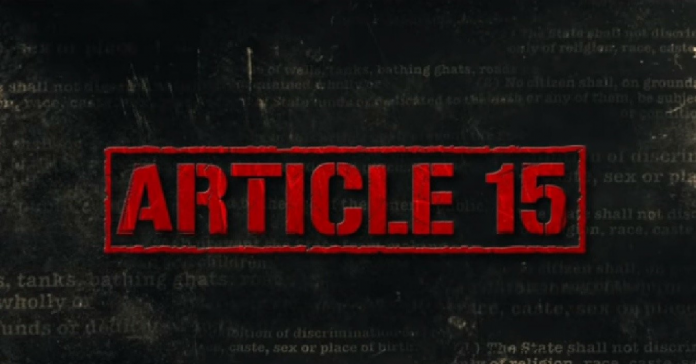
Ayushman khurana’s latest film Article 15 screening were stalled after protesting at different places. The movie is based on casteism which revolves around the brutual gang rape and murder of two girls in Uttar Pradesh’s Badaun district in 2014. Ahead of its release certain Brahmins outfits had alleged that the film portrayed certain members of community(Brahmins) in a “negative light”. This movie has opened a lots of criticism as well as protest by upper caste. Before moving further let’s see what does Article 15 of Indian Constitution says.
ARTICLE 15: Prohibition of discrimination on grounds of religion, race, caste, sex or place of birth.
(1)The State shall not discriminate against any citizen on grounds only of religion, race, caste, sex, place of birth or any of them.
(2) No citizen shall, on grounds only of religion, race, caste, sex, place of birth or any of them, be subject to any disability, liability, restriction or condition with regard to(a) access to shops, public restaurants, hotels and palaces of public entertainment; or(b) the use of wells, tanks, bathing ghats, roads and places of public resort maintained wholly or partly out of State funds or dedicated to the use of the general public.
(3)Nothing in this article shall prevent the State from making any special provision for women and children.
(4)Nothing in this article or in clause ( 2 ) of Article 29 shall prevent the State from making any special provision for the advancement of any socially and educationally backward classes of citizens or for the Scheduled Castes and the Scheduled Tribes
(5) Nothing in this article or in sub-clause (g) of clause (1) of article 19 shall prevent the State from making any special provision, by law, for the advancement of any socially and educationally backward classes of citizens or for the Scheduled Castes or the Scheduled Tribes in so far as such special provisions relate to their admission to educational institutions including private educational institutions, whether aided or unaided by the State, other than the minority educational institutions referred to in clause (1) of article 30.
Article 15 is available to only citizens and not to every persons. let’s understand the meaning of Art. 15 but firstly moving further we should know what does discrimination means?
The word ‘Discrimination’ means to make an adverse distinction or distinguish unfavourably from others.
The word ‘only’ used in Art 15(1) indicates that discrimination cannot be made merely on the ground that one belong to a particular caste, sex, religion etc. and it also directs the state not to discriminate against a citizen on the above mentioned grounds.The right guaranteed is conferred on a citizen as an individual and is available against his being subject to discrimination in the matter of rights, privileges and immunities pertaining to him as a citizen generally.
Art. 15(2) is a specific application of the general prohibition contained in Art. 15(1).It declares that no citizens shall be subjected to any disability, restrictions or conditions on grounds only of religion, race, caste, sex etc. with regard to access to shop, restaurants, well, tanks,ghats, place etc. maintained wholly or partly by state fund.
Art. 15(3) is an exception to Art. 15(1)& (2). it says that nothing in this section will prevent the state for making any special provision for women and children . Women and children needs special treatment because of their very nature and to uplift them in the society. it is a positive discrimination. U/A 42 women workers can be given special maternity belief and a law to this effect will not infringe Art. 15(1).Also reservation for women does bot infringe Art. 15(1).
Art. 15(4) talks about special provisions for the advancement of backward classes. It is an another exception to Art 15(1)&(2). It was added by 1st Constitutional Amendment Act,1951 in the decision of State of Madras V. Champkam Dorairajan, (AIR1951 SC226) SC held that reservation should not be given on the basis of caste and religion and inserted this very clause where only few groups will be granted reservation i.e.
But after 15(4) was inserted 68% seats were reserved and only 32% were left for others, this order was challenged on the case, M.R. Balaji V. State of Maharashtra, (AIR 1973 SC 282) where SC held that reservation should not exceed to 50% and backward class categorisation into more backward class is not valid. while considering positive discrimination one must follow advancement of society at large.
Mandal Commission ( Indira Sawhney v. UOI, AIR 1993 SC 477)
Art. 340 gives power to president to appoint a commission to investigate condition of socially and educationally backward classes. Mandal commission was set up under the chairmanship of Bindeshwari prasad Mandal (MP and CM of Bihar)on !st Jan, 1979 and report was completed in 1980. Commission report recommended that 27% reservation to OBC, SC 15%, ST 7.5% of jobs under central Gov. and Public sector should be given.In 15th Aug., 1990 the then PM, V.P.Singh officially announced its legal implementation in his independence day speech. The hastily implemented decision created deep socio political division along the lines of caste in the north India. Protest erupted specially by students, professor, job seekers of upper caste, these protest closed road, highways, transportation,school,colleges etc. self immolation(to fire oneself) 1st self immolation was done by DU student named Rajiv Goswami and then 159 attempted and 63 died. And then Mandal Commission was challenged in court by Indira Sawhney who was an advocate. On 16th Nov.1992, SC in its verdict upheld the government order to implement mandal commission report being of the opinion that caste was an acceptable indicator of backwardness.
Art.15(5) specifically inserted by 93rd Constitutional amendment act, 2005 to nullify the effect of judgment in P.A. Inamdar case. it talks about only admission to educational institutions whether aided or unaided by state to SEBC, SC,ST.
India- still under Casteiesm?
Once French Scholar Romain Rolland said- “If there is one place on the face of this earth where all the dreams of living men have found a home from the very earliest day when man began the dream of existence, it is India.” Aren’t we breaking the dreams to make a better India. If we talk about casteism first thing that comes in one’s mind is dalits, Sc and Stc. we do have enough of laws but still why casteism follows?
Recently in Bundelkhand, Uttar Pradesh Dalits were not allowed to touch water tankers servicing upper caste villages and this situation were of those times where there were crisis of water in UP.
Again on 8th sept., 2018 in UP students were refused mid day meal prepared by lower caste cook, school then throws all the food after the protest.
This is the condition of Modern India where one side plenty of people are facing death due to hunger and malnutrition and other side wastage of food is done on the basis of casteism.
There are several others incidents which happens daily in our country and if someone wants to show these real incidents through movie then protestors of upper caste alleged that they are portraying negative impact. This movie was protested by Brahmins as the movie portrays anti brahmin. To bring Religion and caste in every aspect of life is disappointing and it is very important to change the mindset of people to create India free from Casteism.
This is an example post, originally published as part of Blogging University. Enroll in one of our ten programs, and start your blog right.
You’re going to publish a post today. Don’t worry about how your blog looks. Don’t worry if you haven’t given it a name yet, or you’re feeling overwhelmed. Just click the “New Post” button, and tell us why you’re here.
Why do this?
The post can be short or long, a personal intro to your life or a bloggy mission statement, a manifesto for the future or a simple outline of your the types of things you hope to publish.
To help you get started, here are a few questions:
You’re not locked into any of this; one of the wonderful things about blogs is how they constantly evolve as we learn, grow, and interact with one another — but it’s good to know where and why you started, and articulating your goals may just give you a few other post ideas.
Can’t think how to get started? Just write the first thing that pops into your head. Anne Lamott, author of a book on writing we love, says that you need to give yourself permission to write a “crappy first draft”. Anne makes a great point — just start writing, and worry about editing it later.
When you’re ready to publish, give your post three to five tags that describe your blog’s focus — writing, photography, fiction, parenting, food, cars, movies, sports, whatever. These tags will help others who care about your topics find you in the Reader. Make sure one of the tags is “zerotohero,” so other new bloggers can find you, too.

 Deeba's blog